
Roundabouts in Ontario, Explained: Yield, Lanes and Signals
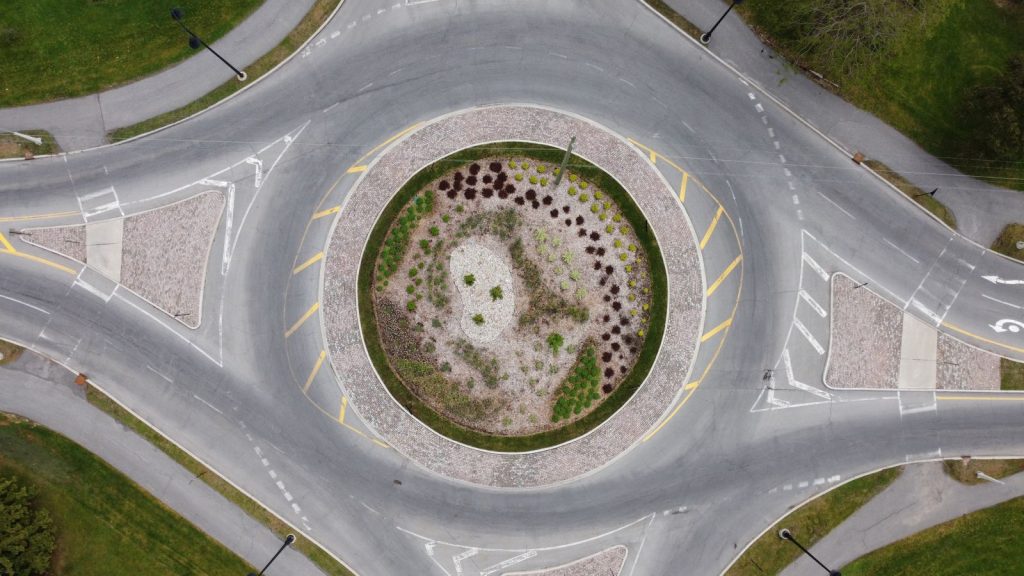
To drive a roundabout in Ontario, slow down on the approach, choose your lane by the exit you want, and yield to traffic already in the circle. Enter only when there is an adequate gap, travel counter-clockwise around the central island without stopping or changing lanes, then signal right after you pass the exit before yours and leave in the same lane you entered in.
Roundabouts still unsettle new drivers because everything happens in one continuous curve. There is no stop sign and usually no traffic light. The Official MTO Driver’s Handbook treats a roundabout as a sequence, not a puzzle: approach, yield, enter, circulate, signal, exit. Learn the sequence and every roundabout in Ontario works the same way.
Approaching: slow down and choose your exit first
As you approach, look for the signs that name the exits and choose yours before you reach the yield line. Choose your lane as you would at any other intersection:
- Use the left lane to turn left or to go straight
- Use the right lane to turn right or to go straight
- Never enter from the right lane if you want to turn left
Slow down and watch for pedestrians on the approach to the yield line at the entrance. Pedestrian crossings sit on every entry and exit leg, set back from the circle, and a pedestrian halfway across your entry is a reason to stop before the line, not inside the roundabout. Stay in the lane you chose. Lane discipline decided here is what makes the rest of the roundabout calm.
Entering: traffic in the circle goes first
Traffic already in the roundabout has the right-of-way. Look to your left, where circulating traffic comes from, and adjust your speed or stop at the yield sign if you need to. Enter only when there is an adequate gap in the circulating flow.
One handbook warning matters here: do not enter directly beside another vehicle that is already in the roundabout, because that vehicle may be about to exit across your path at the next exit. A slightly longer wait for a clear gap is always the cheaper choice. If the roundabout has a single lane, the same rule applies with no lane choice to make: yield, then enter into a gap.
Inside the circle: keep moving, hold your lane
Once inside, always keep to the right of the central island and travel counter-clockwise. Do not stop except to avoid a collision: once you are circulating, you have the right-of-way over traffic waiting to enter, and stopping breaks the flow everyone else is reading.
Do not change lanes while you are in the roundabout. If you are in the inside lane and you miss your exit, the handbook rule is simple: continue around the circle until your exit comes up again. Going around a second time costs a few seconds. Cutting across a lane to grab an exit is how roundabout collisions happen.
Exiting: pass one exit, then signal
Signal your exit so drivers waiting to enter can read the gap you are about to create. The handbook timing is precise: once you have passed the exit before the one you want, use your right-turn signal. Signal too early and waiting drivers may pull in front of a car behind you that is not exiting. Signal too late and nobody benefits.
Maintain your lane on the way out: stay to the left if you entered from the left lane, or to the right if you entered from the right lane. If you are exiting from the left lane, watch for vehicles on your right that are continuing around the roundabout rather than exiting with you. Then watch for pedestrians on the crossing across your exit leg, and be ready to stop for them after you leave the circle.
Trucks, buses and cyclists
Allow extra room alongside large vehicles such as trucks and buses. The handbook notes they may have to swing wide on the approach or within the roundabout, and some roundabouts give them a mountable apron around the central island for exactly that reason. Never try to pass a large vehicle inside the circle.
Cyclists generally keep to the centre of the appropriate lane, like a car, or dismount and use the roundabout as a pedestrian would. Give a cycling rider the full lane rather than squeezing past on entry or exit.
Roundabouts on your road test
Examiners watch roundabouts for the same sequence the handbook teaches: a controlled approach, a real yield rather than a rolling merge, lane discipline, and a timely exit signal. There is no separate roundabout score and Ontario publishes no official pass mark. What an examiner can see clearly is hesitation that blocks the entry, a stop inside the circle, or a missing exit signal. Practising the sequence out loud with an instructor, as we do in our G2 road test preparation guide, turns a stressful circle into a routine.
Frequently Asked Questions
Traffic already in the roundabout. Drivers entering must look left, slow down or stop at the yield sign if necessary, and enter only when there is an adequate gap in the circulating traffic.
Choose your lane on the approach as you would at any intersection. The signal the handbook requires is the exit signal: use your right-turn signal once you have passed the exit before the one you want, so waiting drivers know you are leaving.
Keep circulating. Do not stop and do not change lanes to chase the exit. Continue around the roundabout and take your exit on the next pass. From the inside lane, that is the handbook’s stated rule.
Either lane can go straight: the left lane is for turning left or going straight, and the right lane is for turning right or going straight. Pick based on traffic and where you need to be after the exit, then hold that lane all the way through and out.
No, except to avoid a collision. Once you are in the roundabout you have the right-of-way over entering traffic, so keep moving at a steady speed and let waiting drivers yield to you.
Not quite. The handbook notes that some areas of Ontario still have older traffic circles, which work differently. A modern roundabout always has yield control on every entry and counter-clockwise circulation around a central island. Follow the signs at the one in front of you.
Practise the sequence until it is boring
A roundabout rewards a driver who decides early: exit chosen, lane chosen, yield given, gap taken, signal on, exit taken. If roundabouts on Cornwall and Eastern Ontario roads still make you tense, Malik’s Defensive Driving School practises them with you one-on-one, at your pace. Book a lesson to build the routine before your test.