
Night Driving Tips in Ontario: Headlights, Glare and the Space You Cannot See
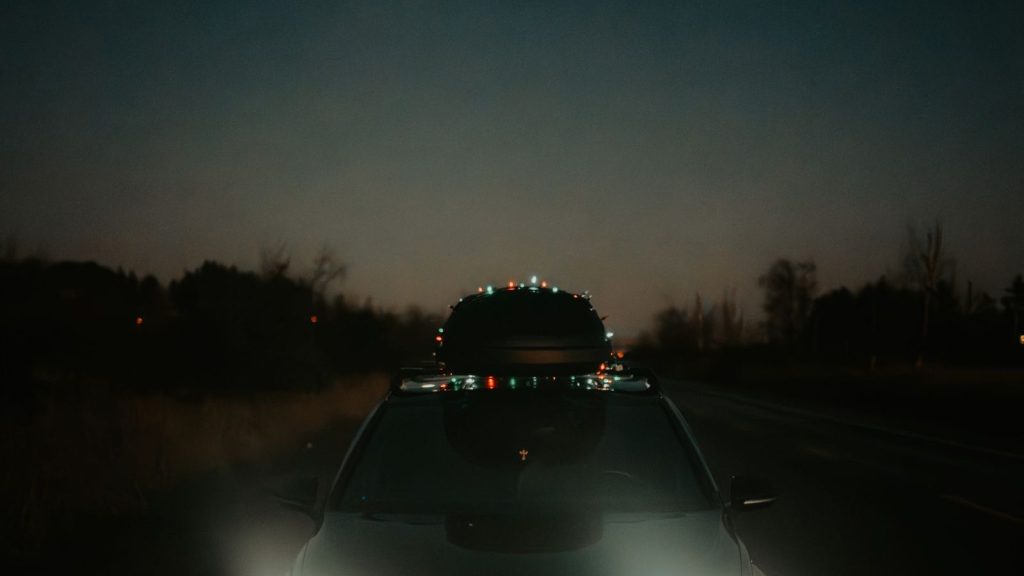
At night you cannot see as far ahead as in daylight, even with your headlights on, so the core night driving skill in Ontario is simple: slow down, use your full lighting system at the right times, and never drive faster than the distance you can actually see. Most night collisions are not caused by darkness itself. They happen because a driver kept a daytime speed and a daytime following distance in conditions that had quietly removed both margins.
Turn on your full lights, not just your daytime running lights
Ontario law requires your full lamps from one-half hour before sunset to one-half hour after sunrise, and at any other time when people and vehicles are not clearly visible at 150 metres or less, for example in heavy rain, snow or fog. Daytime running lights are not enough for this. On many cars they light the front only and leave the tail lights off, so the car is nearly invisible from behind, and a bright dashboard can fool you into thinking your headlights are already on. Turn the switch to ON or AUTO, check for the headlight symbol on the dash, and make a habit of a quick walk-around glance at your tail lights before a night trip in winter, when road salt dims every lens.
Do not overdrive your headlights
You are overdriving your headlights when you go so fast that your stopping distance is farther than you can see with your headlights. On an unlit Eastern Ontario road, your low beams show you only a short stretch of pavement. Anything inside that stretch has to be stoppable, and anything beyond it is unknown, not empty. Reflective road signs can mislead you here, because they shine back brightly and make you believe you can see farther than you can. The fix is speed: slow down at night, especially on unlit roads, until the distance you can see is comfortably longer than the distance you would need to stop.
Use high beams and low beams at the right distances
High beams are for open, empty roads. The Official MTO Driver’s Handbook sets the changeover distances clearly:
| Situation | Beam to use |
|---|---|
| Oncoming vehicle within 150 metres | Low beam |
| Following a vehicle within 60 metres | Low beam |
| Curve or hilltop on a country road | Low beam, so you do not blind a driver you cannot see yet |
| Fog or blowing snow | Low beam, because high beams reflect off the moisture and ice particles and make it harder to see |
| Empty road, no headlights visible | High beam is fine, switch back when headlights appear |
Handle glare without staring at it
Glare is dazzling light that makes it hard to see what other road users are doing, and at night it usually arrives as bright oncoming headlights or headlights reflected in your mirrors. The handbook response is specific: look up and beyond and slightly to the right of the oncoming lights. That keeps the brightest light out of the centre of your vision while you hold your lane position using the right edge of the road. Slow down a little while your eyes recover. Inside the car, dim your dashboard lights, flip the rear-view mirror to its night setting, and keep the inside of your windshield clean, because a smeared windshield turns every oncoming light into a halo.
Give yourself more space and more time
At night, hazards appear later. A pedestrian in dark clothing, a cyclist without lights, or a deer at the edge of a rural road near Cornwall or Hawkesbury may only become visible inside your headlight range. Increase your following distance so you have extra room to brake, avoid passing unless you need to, and watch the edges of your light pool rather than only the centre of it, because movement at the edge is often the first warning. If you are tired, the honest answer is to stop somewhere safe and rest. A slower arrival is a successful trip; a drowsy one may not arrive at all.
Know the licence rules that apply after dark
Night driving is also a licensing question for new Ontario drivers. G1 drivers must not drive at all between midnight and 5 a.m., at any point in the G1 stage. G2 drivers may drive at night, but drivers aged 19 and under face passenger limits between midnight and 5 a.m.: only one passenger aged 19 or under for the first six months of G2, and up to three passengers aged 19 or under after six months. Everyone, at every stage, drives with a zero blood alcohol level while they are a novice driver. Breaking the night rules is not a technicality. It can bring charges and set back your progress through graduated licensing.
Frequently Asked Questions
From one-half hour before sunset to one-half hour after sunrise, and at any time when people and vehicles are not clearly visible at 150 metres or less because of darkness, rain, snow or fog. Use the full lighting system, not just daytime running lights, so your tail lights are on too.
Within 150 metres of an oncoming vehicle, and when following a vehicle within 60 metres. On country roads, also switch at curves and hilltops so you do not blind an oncoming driver you cannot see yet.
Look up and beyond and slightly to the right of the oncoming lights, hold your position using the right edge of the road, and slow down while your eyes recover. Do not stare at the lights and do not flash your high beams back.
Driving so fast that your stopping distance is longer than the distance you can see with your headlights. If something appears at the edge of your light and you could not stop before reaching it, you are overdriving your headlights. Slow down.
A G1 driver can drive in the evening with a qualified accompanying driver, but must never drive between midnight and 5 a.m. That ban applies for the whole G1 stage.
No. Road tests run in daylight hours, so night skill is not examined directly. It is still part of being a safe licensed driver, and the night rules for G1 and young G2 drivers apply from the day the licence is issued.
Practise after dark with support
Confidence at night comes from guided practice: a few calm drives on lit streets, then quieter roads, with someone experienced beside you while your licence allows it. If you are preparing for your G2 or G test in Cornwall or Hawkesbury and want your observation, spacing and speed habits checked by an instructor, our G2 road test preparation guide explains what examiners look for, and you can book a lesson for one-on-one practice at a pace that suits you.